


THE EARLY AMERICAN STILL LIFE TYPES: TABLE-TOP
The sources of American still life are diverse. First of all, it is, of course, the European traditions of Dutch, Flemish, Spanish, English, Italian still life, refracted through the habitat and the specifics of the vision of the American artist, in a different time epoch. Now it’s possible to buy such antique paintings in art galleries, living auctions, even buy online.
The selectivity of the Americans’ drawings from European traditions is indicative. Firstly, it is a type of still life-a showcase presented to the viewer's eye for contemplation and viewing. These are modest, laconic still lifes, strict in the selection of objects located on the counter (table-top still life), with limited space and an indefinite background, - such style is typical for the early stage of this genre in Europe of the late 16 – early 17th century. So, the portrait painter from Boston John Johnston (1753–1818) demonstrates the knowledge of European traditions and the professionalism of the painter in the only one that has come down to us "Still life" (1810). On a neutral-light background, the painter arranges peaches, dark and white grapes into a compact pyramidal group on the corner of the countertop, not missing the opportunity to paint a worm on a branch and a fly right in front of the viewer's eyes. One can buy vintage paintings of John Johnston at art auctions but mostly portraits.
The horizontal-frontal composite structure is used by James Peale (1749–1831; Fruit in a Chinese export basket, 1824), Raphael Peale (Still life: strawberries, nuts. Ca. 1822), choosing either a central motif as a dish or fruit basket, or placing vegetables or fruits with few household items on the table surface. Such compositions are quite numerous and even allowed American art critics to name them as "Peale formula" – as a rule, these are simple arrangements of several fruits or vegetables accompanied by one or two glass, porcelain or ceramic (rarely silver) vessels (jug, glass, decanter) or dishes on an uncertain surface and an equally undefined background, usually dark, sometimes slightly lightening.
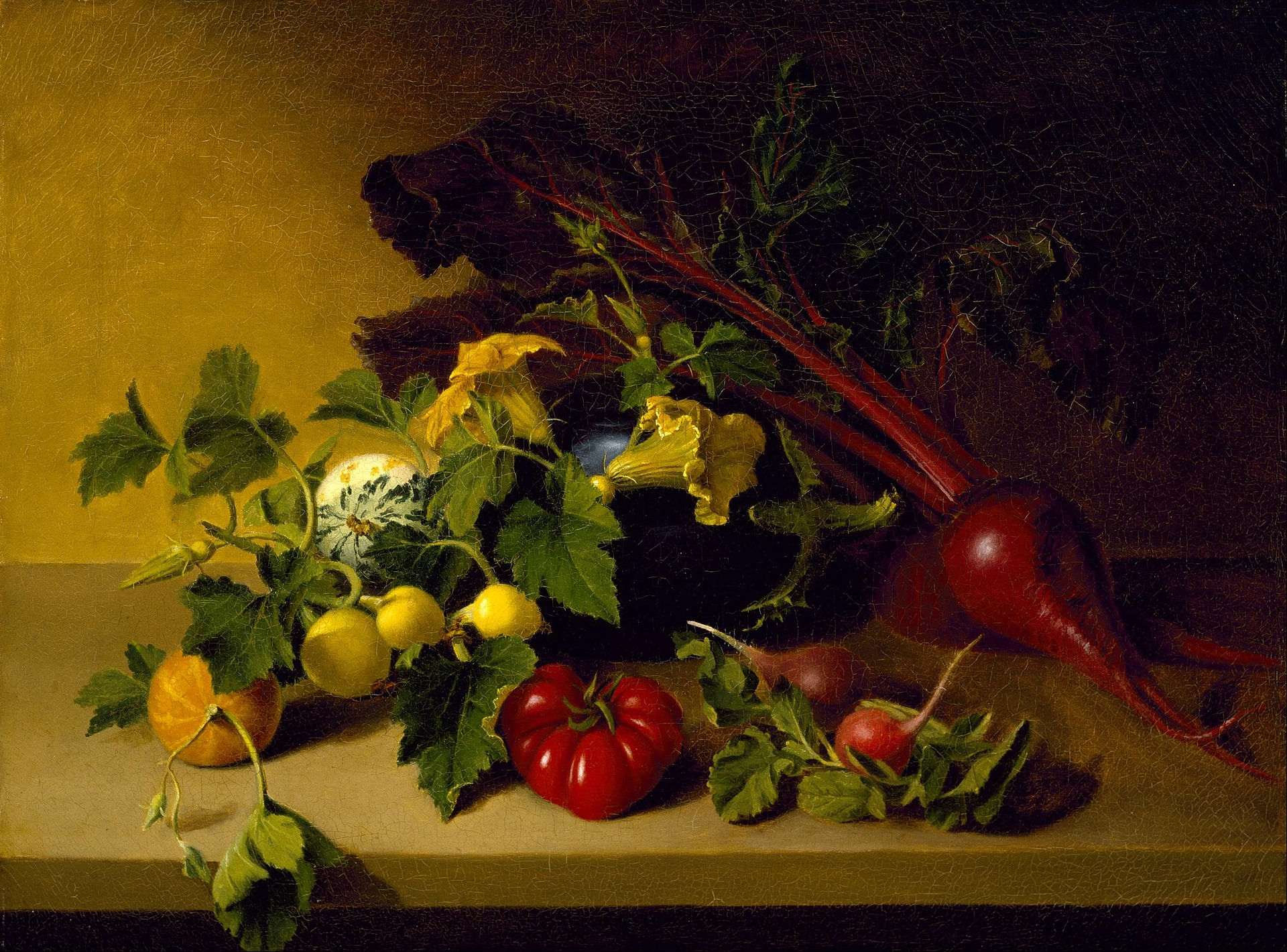 James Peale. Still Life with Vegetables. 1826 Source: Wikipedia
The paintings of Peel circle painters are popular among art-connoisseurs and rated by antique dealers that buy antiques.
Raphael Peale, the recognized founder of the genre, expressed himself most fully in a similar type of still life. The artistic language of R. Peale's staged still lifes is classical in nature. His still lifes are geometrically clearly constructed, the objects are endowed with clarity and purity of lines, while the contours are softened, the colors are nobly coordinated and devoid of artificial brightness. This style fully corresponded to the prevailing aesthetic preferences of that time in art and architecture, focusing on neoclassicism with its principles of order, balance, clarity, simplicity. Raphael Peale antique painting prices are varied a lot but generally rated very high.
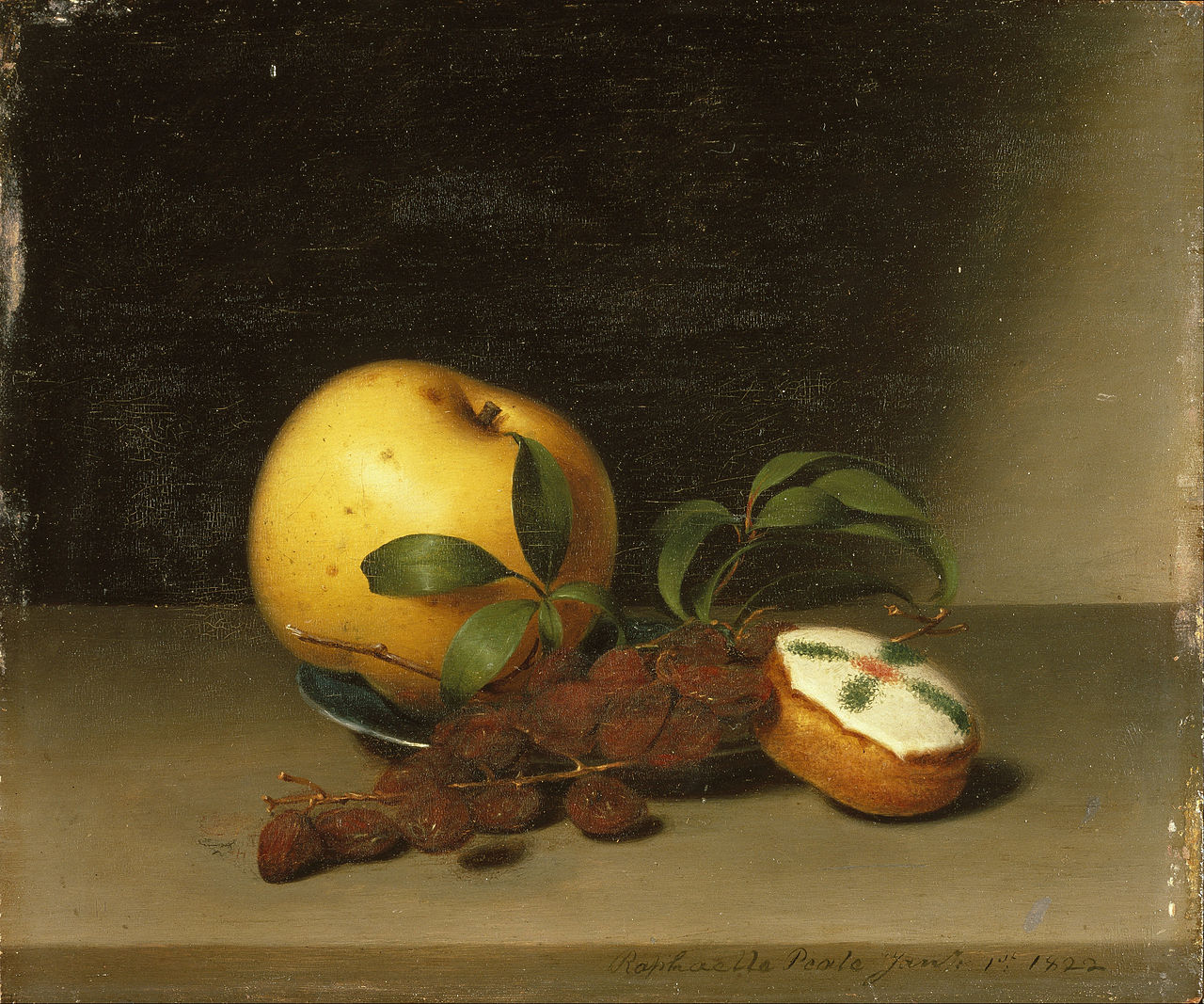
Raphaelle Peale. Still Life with Cake. 1822. Source: Wikipedia

The early American still life created a tradition, ensured the continuity and further development of the genre in the last quarter of the 19th century.
Cover image: James Peale. Fruit Still Life with Chinese Export Basket. 1824. Source: Commons Wikimedia
