


At the beginning of the 20th century the art of Canada started its independent way, in which landscape painting has got predominant importance and highly valued by antique dealers; until that time, it was heavily dependent either on European countries, from where there was an influx of immigrants (mainly from France and England), or on the neighboring United States, where its own art school had developed a century before. By the beginning of the 20th century in painting, imitation of popular English and French portrait and genre painters, its American school of the Hudson River, French Barbizon School or Impressionists prevailed. However, the artists sought out in the life outdoors and nature of Canada what they were used to seeing in the paintings of masters of other schools. The sculptors openly transferred to Canada the impersonal and pompous receptions of the Parisian Salons, filling the city squares, the buildings of parliaments and municipalities with allegories and statues of ministers, governors and bishops. At the same time, the vast country, containing both the expanses of the tundra, and the mighty endless forests, and the boundless prairies, the patriarchal villages of farmers and the rapidly growing industrial cities, provided artists with the widest opportunities.
In the middle of the 19th century two painters acted as "pioneers", explorers of the country. Paul Kane, who undertook a difficult and dangerous journey through the still unexplored forests to the Pacific coast, painted a whole series of naive, but attractive with artless sincerity, portraits of Indians, scenes of Indian life, landscapes of the "Wild West". Cornelius Krieghoff – a Dutch-born who settled in the "French Canada" (Quebec). In the small paintings he quite accurately pictured not only rural taverns, hunting bivouacs, uncomplicated amusements of farmers, but also the brightness of the colors of Canadian autumn forests and sunsets.
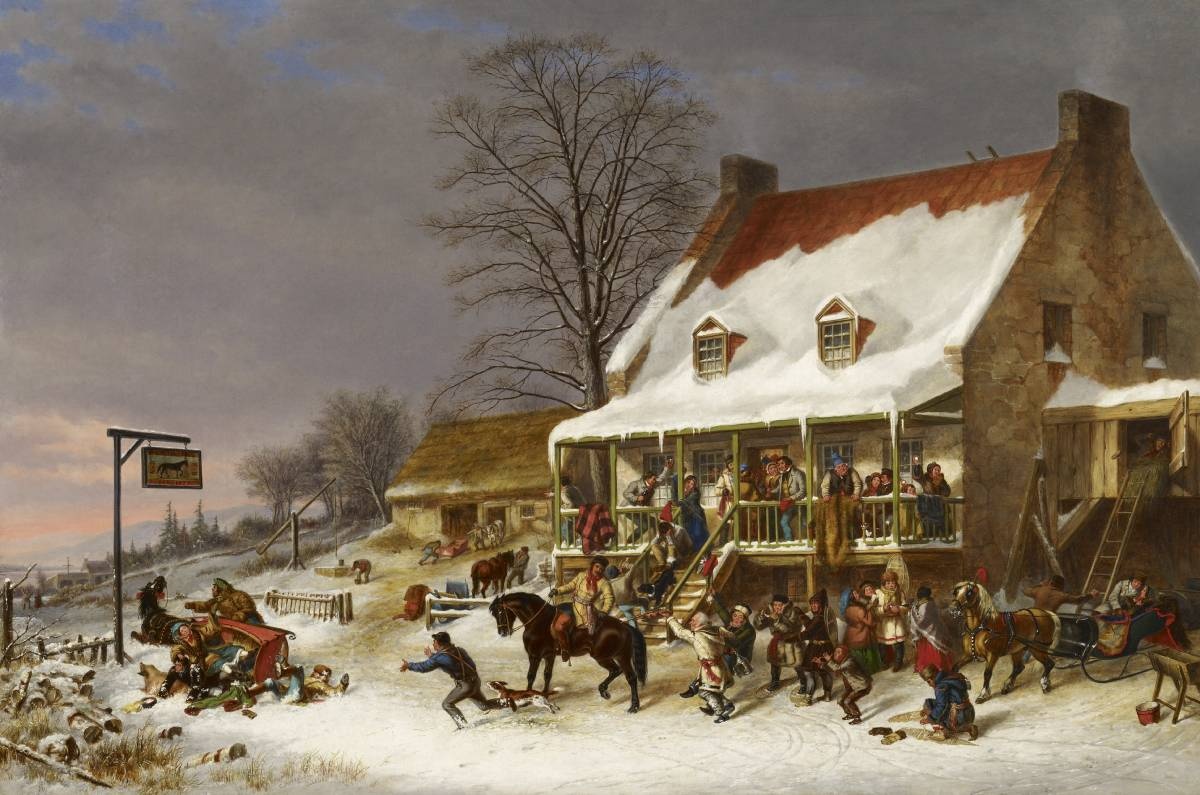
Cornelius Krieghoff. Breaking Up of a Country Ball in Canada, Early Morning, 1857. Oil on canvas, 60.9 x 91.3 cm. The Thomson Collection at the Art Gallery of Ontario.
The early Canadian pictorial art is brilliant as painting for sale which were as sought after in their own time as they are today. In next decades Canadian painting became more professional, but less spontaneous and original. The exception was a few painters, a significant part of whose work, however, covers the early 20th century. Homer Watson certainly learned a lot from his study of the Barbizons, but the dramatic severity and spatial breadth of his landscapes speak of an attempt to understand and express the peculiarity of Canadian nature. Watson is especially interested in landscapes depicting stormy days, storm clouds over farms, flashing lightning, wind-disturbed foliage and turbulent streams (“Gateway”).
Horace Walker, who took a lot from both the Barbizonians and Anders Zorn, is notable for the gloomy elegiacity of forest landscapes, in which the dim northern light seeps through the clouds, glides along tree trunks, and falls on the snow in the dense spots.
The portraits and still lifes of Ozias Leduc are very original, dramatic and gloomy in mood, with sharp contrasts of light and shadow and emphasized plasticity of simplified volumes.
One of the most famous among the Canadian Impressionists is Marc-Aurèle de Foy Suzor-Coté, who painted both landscapes and portraits; his peasant characters are very expressive. He is also known as the sculptor and church decorator.
.jpg)
Marc-Aurèle de Foy Suzor-Côté, Arthabaska, Québec, 1869-1937, Daytona Beach, Florida, USA
A more sensitive artist was Maurice Cullen, perhaps the best master of the Impressionist landscape in Canada. There is a special dreary attraction in his snow-covered cliffs, dense, freezing water of forest backwaters (“Deep Backwater”), in the lonely lights of old Montreal houses shrouded in a frosty evening haze.
The most brightly an independent Canadian art school showed itself in the landscape painting of the first decades of the 20th century.